






[Key Highlights]
- The Honor: Awarded the 2026 Crafoord Prize in Geosciences, worth ~$900,000.
- The Discovery: Proved CFCs are “super-greenhouse gases,” leading to the Montreal Protocol.
- The Impact: His work on “Atmospheric Brown Clouds” linked pollution to Himalayan glacier melt.
- The Roots: Born in Madurai, educated at Annamalai University and IISc Bangalore.
Table of Contents
Veerabhadran Ramanathan, the Indian-origin climate scientist celebrated in recent global headlines, has been awarded the 2026 Crafoord Prize by the Royal Swedish Academy of Sciences—an honor frequently dubbed the “Nobel of Geosciences.”
This prestigious recognition highlights his groundbreaking work on atmospheric pollutants, super-greenhouse gases, and their role in accelerating global warming, marking a historic milestone for scientists of Indian descent.


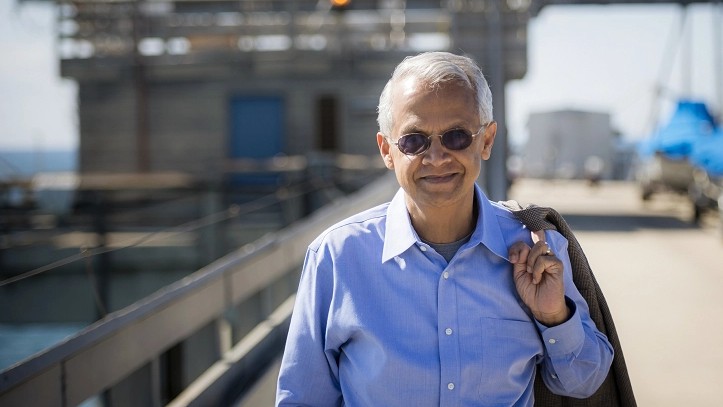
Prof. Veerabhadran Ramanathan, winner of the 2026 Crafoord Prize.
From Madurai to the World: Early Life and Formative Years
Veerabhadran Ramanathan was born on November 24, 1944, in Madurai, Tamil Nadu. Although his roots are in the temple city, he spent much of his childhood in Chennai and later moved to Bangalore at age 11. Growing up in a modest Tamil-speaking family, his transition to an English-medium school instilled a resilience that would define his career.
His upbringing in post-independence India emphasized practical problem-solving. Stories from his youth reveal a boy who fixed household gadgets and pondered natural phenomena like monsoon clouds. This blend of cultural reverence for nature and scientific inquiry became his hallmark.
Engineering a Climate Legacy: The Academic Path
Ramanathan’s journey began not in climate science, but in engineering. He earned his Bachelor of Engineering (B.E.) from Annamalai University in 1965 and a Master’s from the prestigious Indian Institute of Science (IISc) in Bangalore in 1970.
Remarkably, his career ignited on a factory floor. Working as a junior engineer at Shri Ram Refrigeration Industries in Secunderabad, he handled chlorofluorocarbons (CFCs) daily. This hands-on exposure to industrial gases sparked a curiosity that would later lead to his Ph.D. at the State University of New York and a career-defining move to NASA.
Groundbreaking Achievements: Redefining Climate Science
Ramanathan’s discoveries have fundamentally reshaped our understanding of the planet:
1. The Super-Greenhouse Effect (1975)
He co-authored a seminal paper showing that CFCs are not just ozone-depleting agents but “super-greenhouse gases.” He demonstrated that one molecule of CFC traps 10,000 times more heat than CO2. This discovery was a catalyst for the 1987 Montreal Protocol.
2. Atmospheric Brown Clouds (ABCs)
Leading the Indian Ocean Experiment (INDOEX), he mapped vast layers of soot and pollution dimming the skies over South Asia. His research proved these “brown clouds” were reducing sunlight by 10-15%, weakening the monsoon and accelerating Himalayan glacier melt.
Visual: How atmospheric brown clouds impact the Himalayas and agriculture.
3. Project Surya: Science in Action
Believing that “Science without action is futile,” Ramanathan launched Project Surya. This initiative provides solar cookers to rural women in India, cutting black carbon emissions from biomass burning and directly improving health and climate outcomes.
Project Surya: Replacing biomass stoves with clean solar energy.
Philosophy and Future Impact
At 81, Ramanathan resides in La Jolla, California, but remains deeply connected to his Indian roots. A vegetarian who practices yoga and draws from Ayurvedic principles, he often credits spirituality for his focus.
The 2026 Crafoord Prize is not just a personal victory; it is a validation of the “Global South” perspective in climate science. His legacy teaches us that the solution to planetary threats often lies in bridging advanced technology with humble, on-the-ground action.